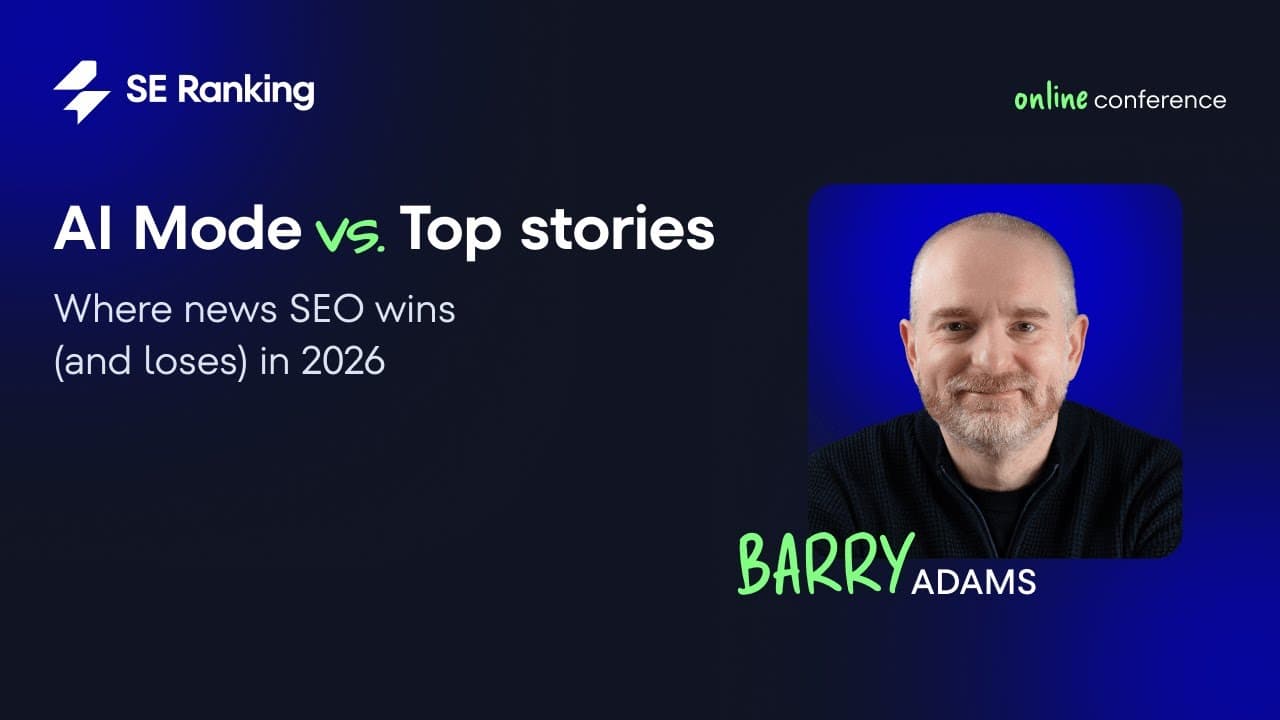
Barry Adams
Key takeaways
- 5:06AI Overviews are not deployed on breaking news queries with top stories boxes, giving publishers a smaller window (6-8 hours vs. previously 2 days) to capture top stories visibility before AI summaries take over.
- 9:12Click-through rates from AI features to publisher sites are dramatically lower than from traditional search results; studies show 34.5% average reduction in clicks after AI Overviews launch, contradicting Google's public statements.
- 14:17AI Mode users do not click through to cited news sources; they stay within the AI experience, making it a 'real traffic killer' for news publishers despite low adoption rates of 75 million daily users.
- 21:22Publishers must build brand loyalty and direct audience relationships to survive AI-first search; commodity publishers offering indistinguishable content from competitors will likely disappear in the next two to five years.
- 16:18Web Guides represent a middle ground between classic search and pure AI, clustering content by subtopics with short summaries and linked sources, reducing traffic impact compared to AI Overviews while still improving user experience.
Questions Barry Adams answered
Barry clarifies that while Google is increasing total queries, the percentage of clicks sent to websites as a proportion of search volume is declining; publishers maintaining traffic are actually winning.
AI Mode vs. Top stories: Where news SEO wins (and loses) in 202623:26
Barry explains LLMs cannot be prevented from hallucinating; they make up answers when uncertain. Providing accurate data just means the LLM will show it without sending traffic to the source.
AI Mode vs. Top stories: Where news SEO wins (and loses) in 202624:27
News SEO wins in the moment of urgency and news creation when stories are fresh (6-8 hour window). Once stories become older, AI-generated summaries catch up quickly and provide sufficient answers.
AI Mode vs. Top stories: Where news SEO wins (and loses) in 202628:31
Publishers should adapt to how audiences actually consume news, such as podcasts, video formats, and platforms like TikTok. Publishers are generally slow to change and should follow others' experimentation rather than being first adopters.
AI Mode vs. Top stories: Where news SEO wins (and loses) in 202629:31
Barry criticizes excessive ad density and pop-ups; even 20% ad density is too high. Publishers should make ads integral to content rather than interruptive, and build direct advertiser relationships instead of relying on problematic programmatic advertising.
AI Mode vs. Top stories: Where news SEO wins (and loses) in 202631:36
In Barry Adams's words
“They're only smart in the sense that a dictionary is smart. They don't create new knowledge. They don't create new insights. They just regurgitate what they ingest.”
AI Mode vs. Top stories: Where news SEO wins (and loses) in 20261:00
“AI Overviews cost us traffic. It's as simple as that. Users do not click from AI Overviews to cited sources as often as they click from a classic list of 10 blue links.”
AI Mode vs. Top stories: Where news SEO wins (and loses) in 20269:12
“People just don't click. They just don't click. When you're in AI Mode, you tend to stay in AI Mode. You don't need to click to websites.”
AI Mode vs. Top stories: Where news SEO wins (and loses) in 202613:16
“If half those Formula 1 news websites were to disappear tomorrow, nobody would really care except maybe the people who work for them. Don't be a commodity publisher that just writes what everybody else is writing.”
AI Mode vs. Top stories: Where news SEO wins (and loses) in 202622:23
“You cannot rely on programmatic to save the day. It's just going to ruin your website no matter how you integrate it.”
AI Mode vs. Top stories: Where news SEO wins (and loses) in 202632:36