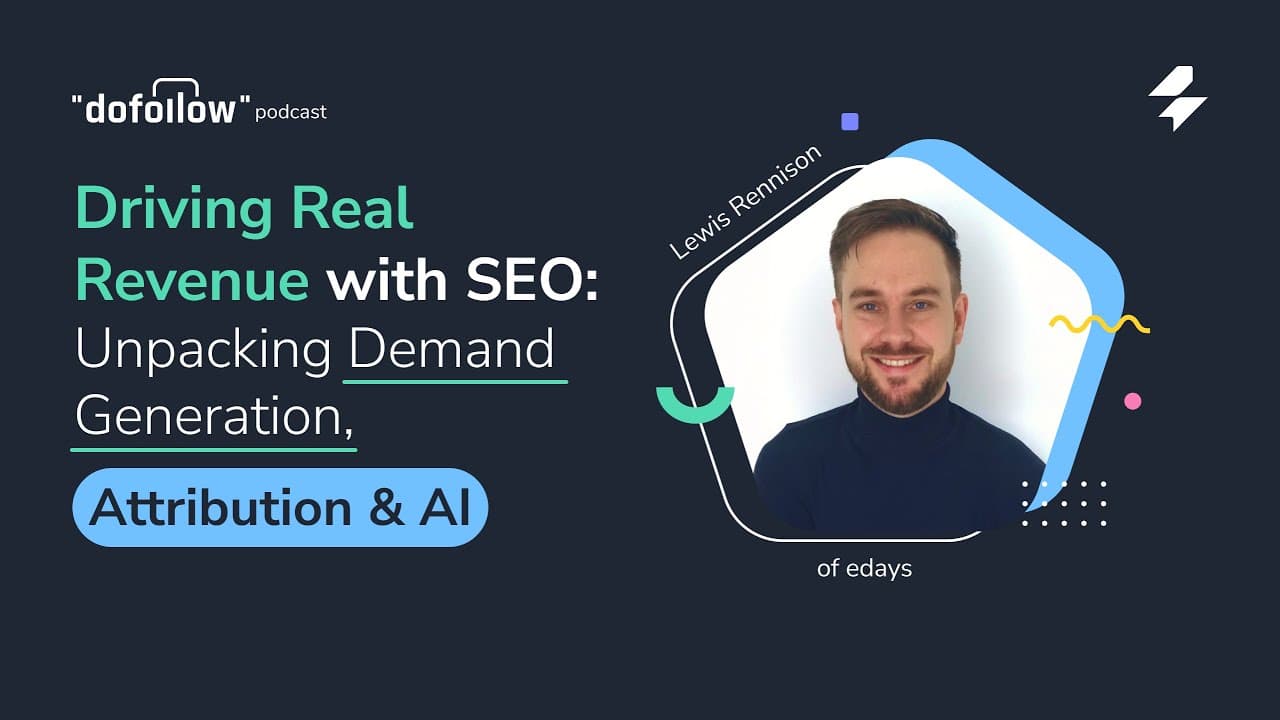
Lewis Rennison
Key takeaways
- 2:02Start with revenue attribution: identify which channels actually drive revenue by analyzing first-click vs. last-click conversions, then work backward to understand your golden channel.
- 4:03Focus on 20-25 high-intent commercial keywords that drive the majority of SEO revenue for in-market products, rather than spreading effort across hundreds of low-intent terms.
- 8:32SEO and PPC are complementary, not competitors—they work together across the buyer journey; ranking number one organically does not eliminate the need for paid ads, as users still click paid results.
- 19:19AI overviews are now scraping your brand and competitor information into search results; actively monitor and influence these overviews by publishing fresh, well-structured comparison content.
- 16:39Distribution beyond SEO and PPC is essential—use media partners, offline events, research reports, and thought leadership to reach buyers outside search's finite audience and drive continuous revenue growth.
Questions Lewis Rennison answered
Work backward from revenue: identify what drives revenue, then trace where it came from. Strong attribution is essential—understand which leads actually convert, whether it's PPC, organic, Bing, or Google.
Driving Real Revenue with SEO: Unpacking Demand Generation, Attribution & AI2:25
For in-market audiences, 20-25 commercial keywords drive the vast majority of revenue. Focus effort on these high-priority keywords because buyers are almost ready to purchase, unlike top-of-funnel keywords which drive far less revenue.
Driving Real Revenue with SEO: Unpacking Demand Generation, Attribution & AI4:23
Measure first-click and last-click to understand how channels work together. Use paid and SEO for in-market, commercial activity, and content marketing for out-of-market, educational top-of-funnel demand generation 6-12 months before prospects are ready to convert.
Driving Real Revenue with SEO: Unpacking Demand Generation, Attribution & AI6:23
Even when ranking number one organically, some users still click paid ads. Capture both audiences because they provide different user behaviors. Use analytics to understand touchpoints and optimize spend between channels based on their complementary roles.
Driving Real Revenue with SEO: Unpacking Demand Generation, Attribution & AI8:32
Use analytics tools like HubSpot or Salesforce with GA connector to track first-click and last-click. Build both reports to understand how long the journey is between first and last click, then use that data to decide whether to optimize for first-click or last-click ROI.
Driving Real Revenue with SEO: Unpacking Demand Generation, Attribution & AI10:15
In Lewis Rennison's words
“You've got to get under the hood of what the attribution model looks like or what the attribution actually is for revenue.”
Driving Real Revenue with SEO: Unpacking Demand Generation, Attribution & AI2:02
“We focus on a handful of keywords that drive the vast vast majority of our SEO based revenue. It might be 25 keywords that we class as high priority.”
Driving Real Revenue with SEO: Unpacking Demand Generation, Attribution & AI4:03
“Your journey online requires multiple touch points. You've got to look at PPC and SEO as complementary.”
Driving Real Revenue with SEO: Unpacking Demand Generation, Attribution & AI8:07
“Distribution is massively overlooked. There are lots of other channels to distribute content and engage your buyer and that engagement is key.”
Driving Real Revenue with SEO: Unpacking Demand Generation, Attribution & AI16:39
“The way that your brand is showing up online is changing because AI overview is scraping top level information about your brand.”
Driving Real Revenue with SEO: Unpacking Demand Generation, Attribution & AI19:19